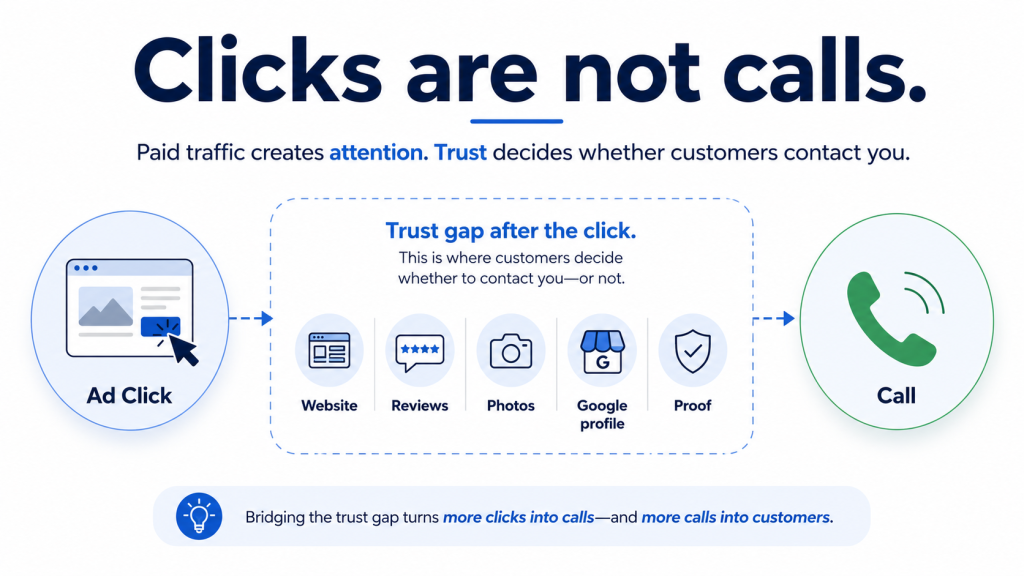
A paid ad can do its job and still fail to produce enough business.
That sounds contradictory, but it is one of the most common patterns we see with small and local businesses.
The ad gets attention.
The customer clicks.
The campaign reports activity.
The owner sees impressions, clicks, or traffic.
But the phone does not ring enough.
When this happens, many businesses immediately blame the ad. They change the creative, adjust the targeting, raise the budget, hire another agency, or pause the campaign completely.
Sometimes the ad really is the problem.
But often, the larger issue happens after the click.
Customers do not decide from one touchpoint
A customer rarely sees one ad and immediately chooses the business.
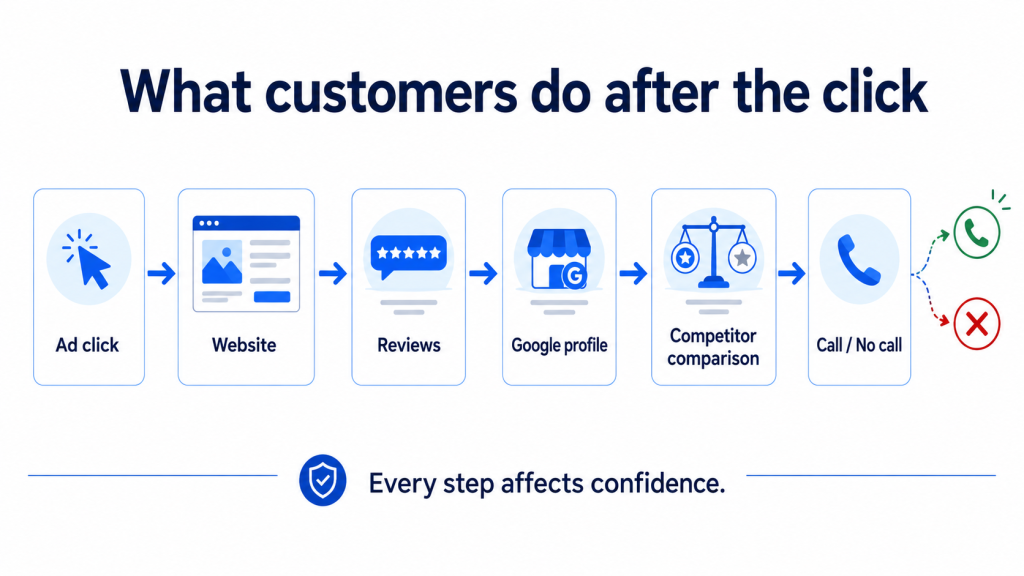
More often, the ad starts a comparison process.
After clicking, the customer may check the website. Then they may search the business name. Then they may look at Google reviews. Then they may compare photos, service pages, recent activity, and competitors.
This is especially true for home services, local services, specialty repair, construction, beauty, wellness, legal, financial, and other trust-based businesses.
The customer is not only asking:
“Can this company do the job?”
They are also asking:
“Do I feel confident enough to call them?”
That confidence is built through a path, not a single ad.
The hidden leak: attention without trust
A weak customer decision path can make paid traffic expensive.
The business pays for the click, but the customer does not get enough confidence to act.
Common trust-path leaks include:
- The website does not clearly explain the service.
- The Google Business Profile looks outdated.
- Reviews are strong but not connected to the specific service being searched.
- Photos do not show enough proof of recent work.
- Competitors look more active or more specialized.
- The business has proof, but the proof is scattered.
- The offer is unclear.
- The customer does not know what happens after they contact the business.
None of these problems means the business is bad.
It means the proof is not organized around the customer’s decision.
Why “more ads” is not always the answer
More ad spend can create more attention.
But if the trust path is weak, more attention can also mean more leakage.
This is why a business can spend for months and still feel stuck.
The ad platform says something is happening. The reports show movement. The business owner sees activity. But the actual business impact does not match the spend.
That gap creates frustration.
The owner thinks:
“I am already spending money. Why is this still not working?”
That is the emotional reality of the Performance Frustrated Spender.
They are not inactive. They are not ignoring marketing. They are already trying.
The issue is that marketing activity is not the same as a customer decision system.
What to inspect before changing the ad
Before raising the budget or changing agencies, inspect the path after the click.
Ask five questions:
- When a customer lands on the website, is the service instantly clear?
- Does the page reduce uncertainty or create more questions?
- If the customer searches the business name, what appears first?
- Do the reviews, photos, and service proof support the specific offer in the ad?
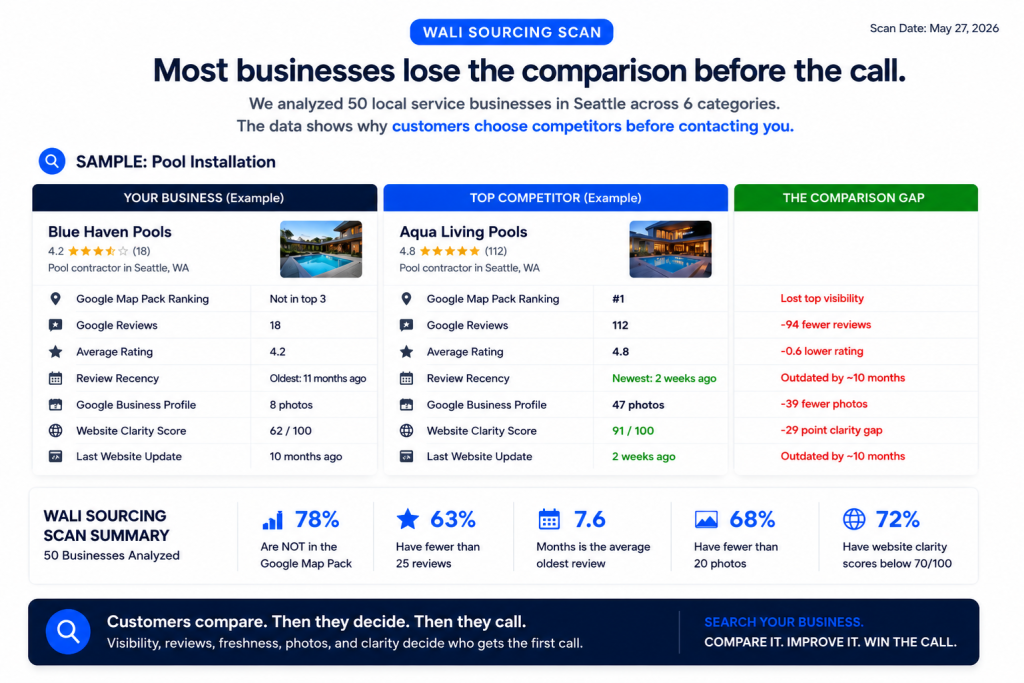
- If the customer compares two competitors, which one looks easier to trust?
These questions are simple, but most businesses do not review them as one system.
They review ads as ads.
Websites as websites.
Reviews as reviews.
SEO as SEO.
Social as social.
Customers do not think that way.
They experience all of it as one decision.
What Wali AI looks for
When Wali AI reviews a business, we do not start by assuming the answer is “run more ads.”
We look at the customer decision path.
That includes visibility, trust signals, reviews, website clarity, proof packaging, local search presence, and the gaps competitors may be using to win.
The goal is not more marketing activity.
The goal is to make the business easier to find, easier to trust, and easier to choose.
For some businesses, that may involve paid ads.
For others, the first fix is visibility.
For others, it is proof packaging.
For others, it is the website or Google profile.
The right answer depends on where the customer loses confidence.
The real question
If your ads are running but customers still choose competitors, do not only ask:
“Is the ad working?”
Ask:
“After the ad gets attention, does everything else help the customer choose us?”
That is where many campaigns are won or lost.