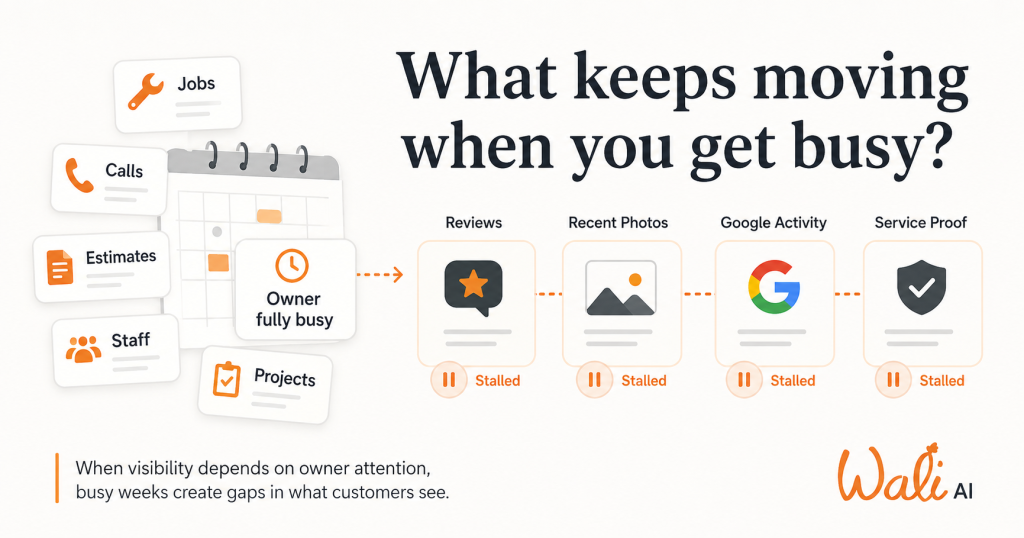
The weeks when a local service business is busiest are often the same weeks its marketing starts going quiet.
Jobs need attention. Customers call. Employees need answers. Estimates pile up. A project runs late. Something breaks. The owner handles what is urgent because that is what keeps the business moving today.
Then the public-facing work slips.
A recent project never becomes a photo. A strong customer comment never turns into visible proof. The Google profile goes untouched. A service page still describes what the company offered a year ago. Review follow-up waits until someone remembers.
None of this means the owner does not care about marketing. Usually the opposite is true. The owner knows it matters. The problem is that too much of the marketing still depends on the owner noticing, remembering, approving, forwarding, posting, or chasing it.
That creates a fragile kind of consistency.
When the owner becomes the workflow
Picture a busy home-service company.
The owner is involved in sales, job quality, staffing, scheduling, customer issues, and cash flow. Marketing is important, but it competes with work that feels more immediate.
On a calm week, the owner can send photos, ask for reviews, update a page, check Google, answer a marketing vendor, and think about what should happen next.
On a chaotic week, almost all of that can stop.
The business itself may be performing well. The public proof of that work can still fall behind.
That distinction matters because a new customer cannot see how busy the owner is. They only see what is visible.
They see whether recent work is easy to find. They see whether reviews feel current. They see whether the website still matches the service they want. They see whether the business looks active when they search.
Operational success does not automatically update those signals.
The hidden cost is not one missed post
It is easy to treat this as a content problem: “We missed a post this week.”
That is usually too narrow.
The bigger issue is owner-dependent execution. When the same person who runs the business also has to trigger every visibility task, marketing becomes uneven by design.
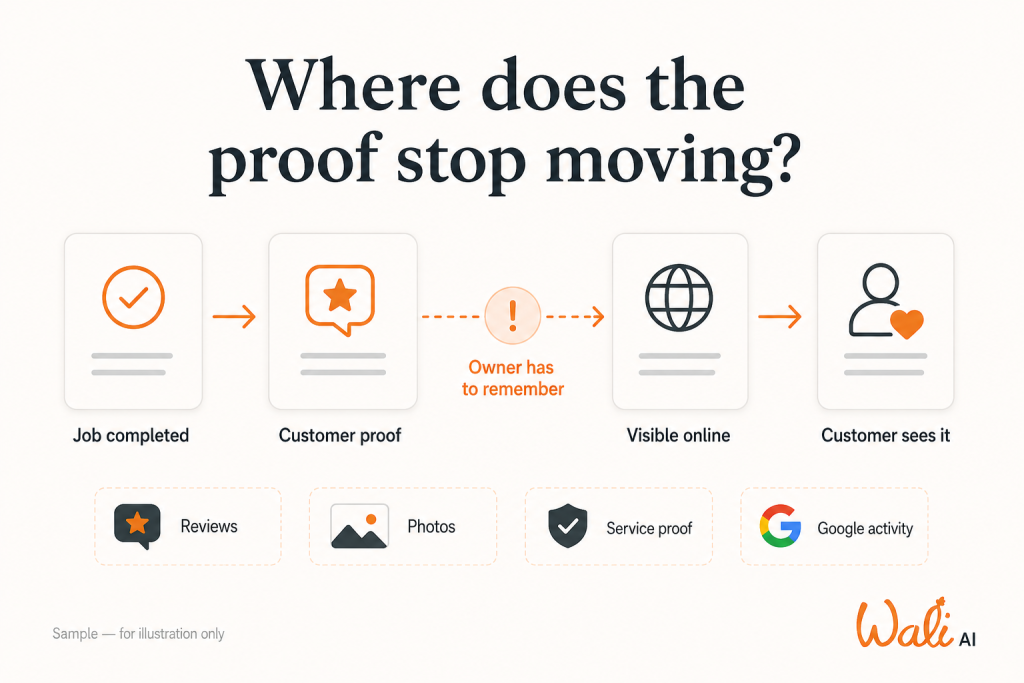
The result is not just fewer posts. Different parts of the customer decision path start aging at different speeds.
The business may have excellent new work but old photos.
It may have happy customers but weak review freshness.
It may have expanded into a profitable service but still have a website that barely mentions it.
It may have strong local demand in one area while no one is checking how the business appears in the next city it wants to grow.
The underlying question is simple:
What keeps moving when the owner gets busy?
If the answer is “almost nothing,” the constraint is not another marketing idea. The constraint is dependence on owner attention.
A useful proof point: visibility should continue after hours
One local-service client described the value of the work as visibility continuing while the team was sleeping.
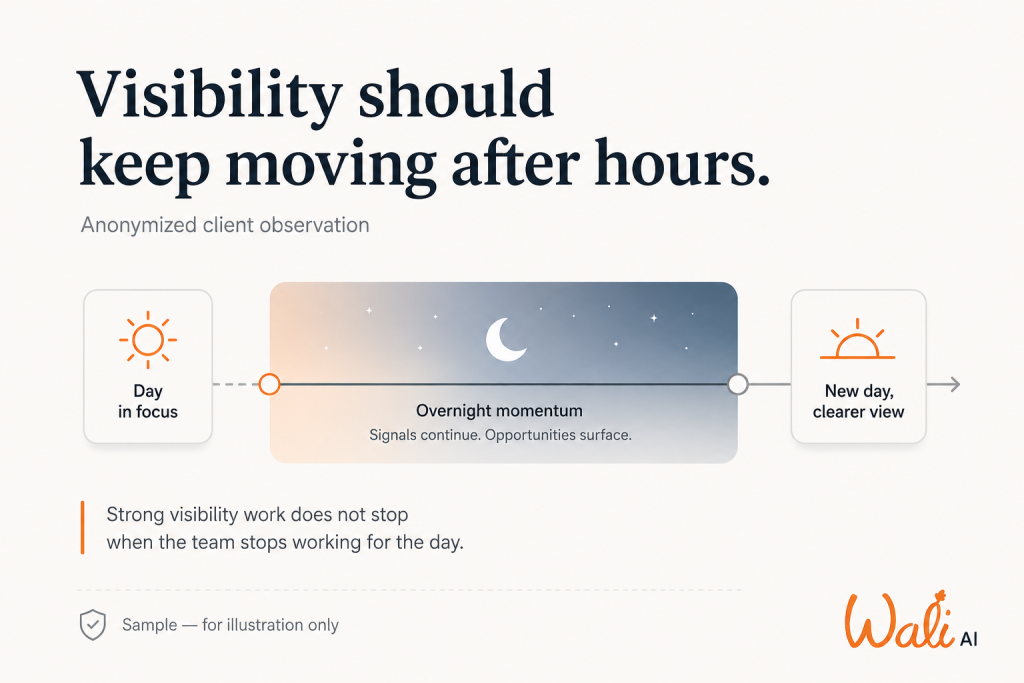
The point was not that owners should ignore marketing. It was that the business should not require the owner to manually push every visibility task forward.
That is a different standard from occasional marketing activity.
A good month should not depend on whether the owner happened to have three quiet afternoons.
A busy week should not make the business look less active online precisely when the company is doing some of its best work.
The strongest proof often exists during the busiest periods: completed jobs, customer feedback, new project photos, service expertise, and evidence that the company is trusted. If those signals stay trapped inside operations, the public view can become weaker while the real business becomes stronger.
What to examine before adding more marketing
Before a busy local service business adds another channel, campaign, or content commitment, it is worth checking where owner attention is currently required.
At Wali AI, a Customer-View Scan looks at what customers can actually see before they contact a business. Depending on the situation, that includes Google visibility, review freshness, photo freshness, website clarity, service proof, competitor comparison, and AI-answer presence.
For an owner-time problem, the diagnostic questions are slightly different:
Where does visible proof stop moving when the owner stops touching it?
Which customer-facing signals depend on someone remembering to update them?
Does recent work become visible while it is still recent?
Do the services the business wants to grow appear clearly in the places customers research?
Can the owner tell what has gone stale without manually checking every channel?
These questions reveal the gap without assuming the fix.
A business may need better ownership, a clearer operating rhythm, a narrower set of priorities, or different support. The right answer depends on the actual business and the live customer view.
The goal is not more activity
Busy owners are often offered more things to do.
Post more. Film more. Ask for more reviews. Update more pages. Try another AI tool. Check another dashboard.
That can make the problem worse if every new activity creates another task that eventually returns to the owner.
The better test is whether the visibility work can stay connected to the business without becoming another job the owner has to babysit.
Marketing should reflect what the company is already doing well: the jobs completed, the services customers value, the areas the business wants to grow, the proof customers create, and the questions prospects ask before calling.
When that connection is weak, the public story falls behind the real business.
When it is strong, a busy week produces more proof instead of less visibility.
A two-week self-check
Think about the last two weeks when your business was genuinely busy.
What happened publicly during those weeks?
Did new customer proof appear?
Did recent work become visible?
Did your Google presence, website, or service proof stay current?
Did anything keep moving without you personally remembering to push it?
If the business goes quiet online whenever the owner gets busy offline, that is a useful signal.
The problem may not be a lack of marketing effort.
It may be that too much of the marketing still depends on you.